What is a boat speed polar?
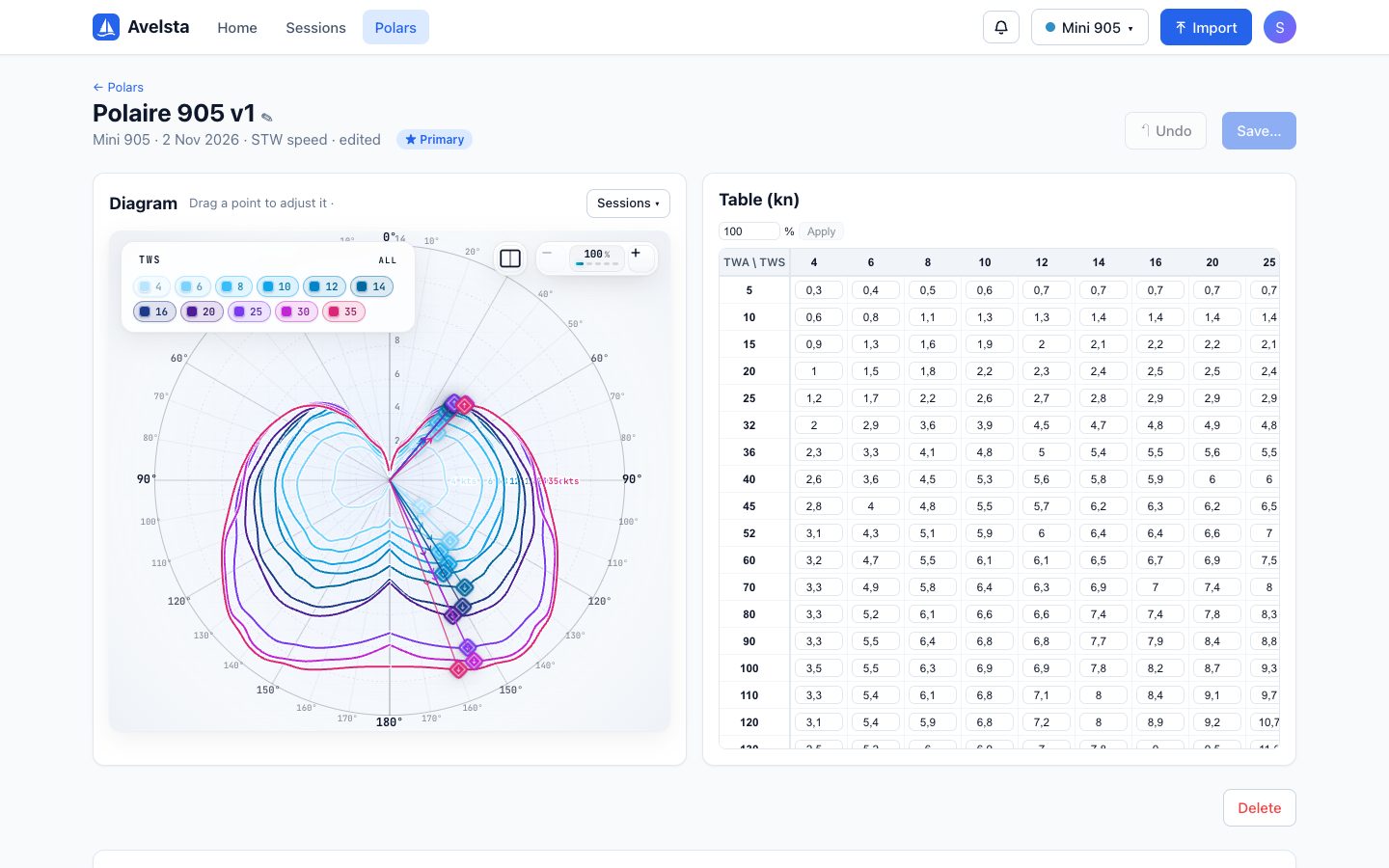
A sailboat’s speed polar gives the target speed for each true wind angle and true wind speed (TWA, TWS). Reading the diagram and the table, theoretical polar and measured polar.
The essentials
A sailboat’s speed polar gives the speed the boat can reach for each true wind angle (TWA) and each true wind speed (TWS). It is the reference used to judge a performance: at 45° to the wind in 12 knots, this boat should sail at, say, 5.7 knots.
- The table: one row per angle (TWA), one column per wind speed (TWS), the target speed in each cell.
- The diagram: one curve per wind speed, drawn in polar coordinates. The angle reads around the circle (0° head to wind, 180° dead downwind), the speed along the radius.
- The further the curve is from the centre, the faster the boat at that angle.
Going further
Reading the diagram
Each colour is a wind speed (4, 6, 8 knots…). The diagram is symmetrical: a boat sails as fast on starboard tack as on port tack. The markers on each curve show the optimal angles: the best VMG upwind and downwind, where the boat gains or loses ground fastest along the wind axis.
In Avelsta, click a wind speed chip to isolate it, double-click to add or remove it, and switch between half and full circle.
Theoretical polar, measured polar
| Polar | Origin | Use |
|---|---|---|
| Theoretical (designer, VPP, rating) | Computed from the boat’s design | Starting reference, often optimistic |
| Reference | Library of more than 510 models in Avelsta | Starting point when you don’t have your own |
| Measured | Generated from your sessions | What your boat really does, with your crew and your sails |
A good working polar often starts from a theoretical or reference polar, then gets adjusted with measurements.
What is the polar used for in Avelsta?
- Computing the polar percentage of every moment and every session.
- Drawing the target speed (dashes) on the timeline.
- Placing the boat on the diagram during the replay.
STW or SOG
Each polar states the speed it describes: STW (through water, recommended) or SOG (over ground, current included). The polar percentage always compares the polar with the same speed.
Frequently asked questions
Why does the polar stop at around 30°?
Below about 30° to the true wind, a sailboat can no longer make way efficiently: speeds there are low or zero.
Is my theoretical polar reliable?
It is a useful benchmark but assumes a perfect boat, sails and crew, in flat water. Compare it with your measurements: a generated polar shows the real gap.